
LUMENIS IO — EARLY DETECTION RESEARCH INITIATIVE
Identifying pre-formation structures in non-equilibrium Earth systems


Prototype Validation and Ongoing Research
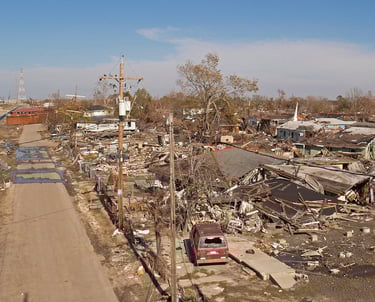
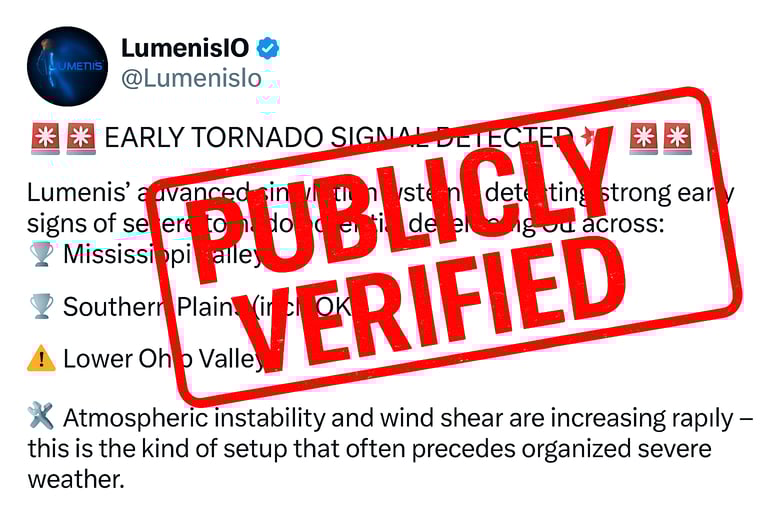
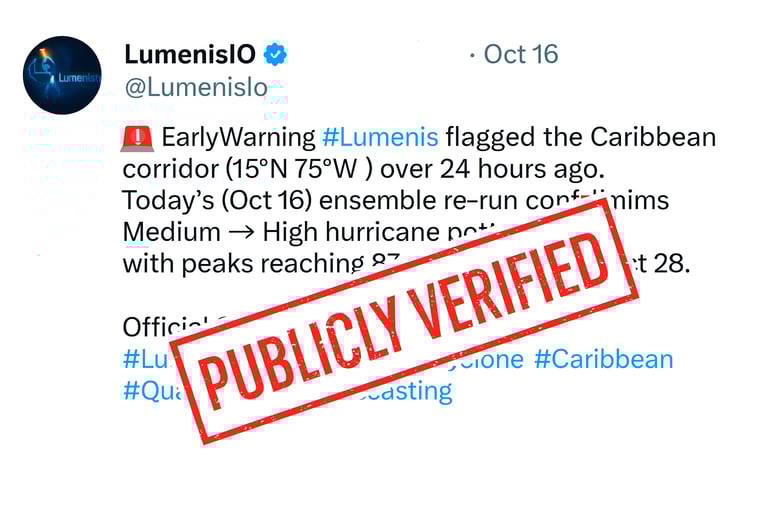
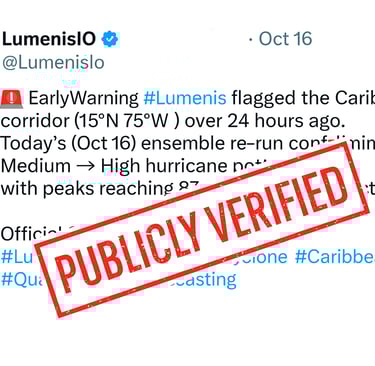
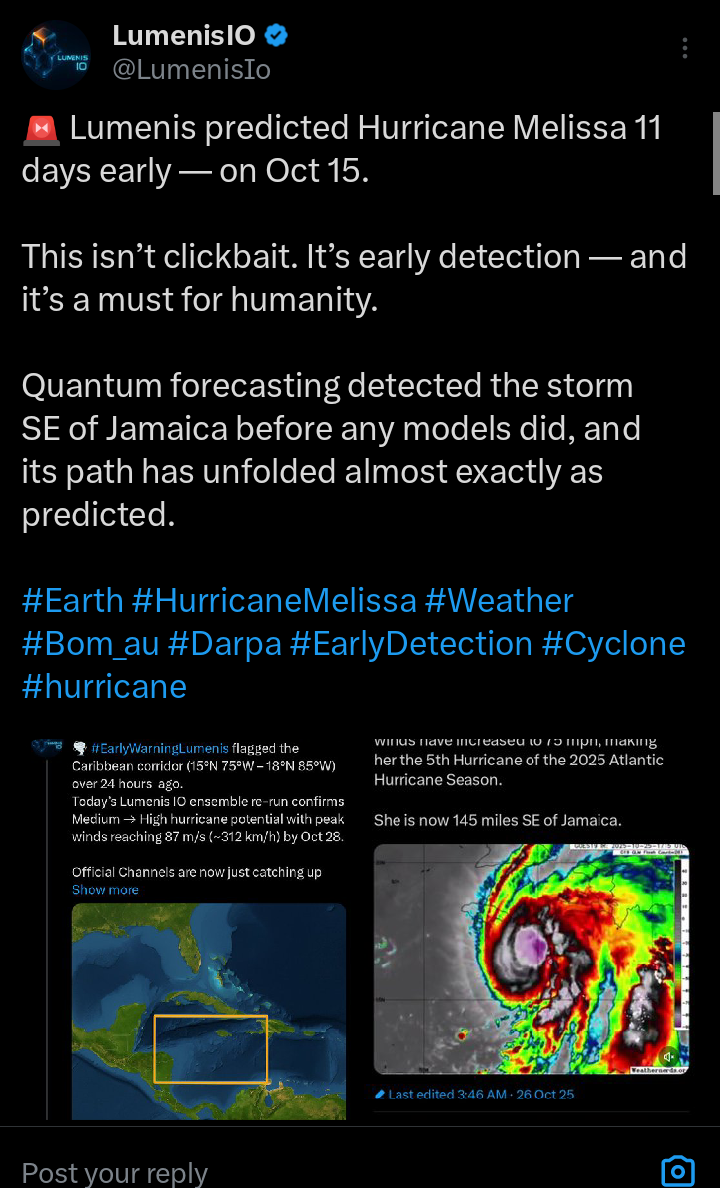
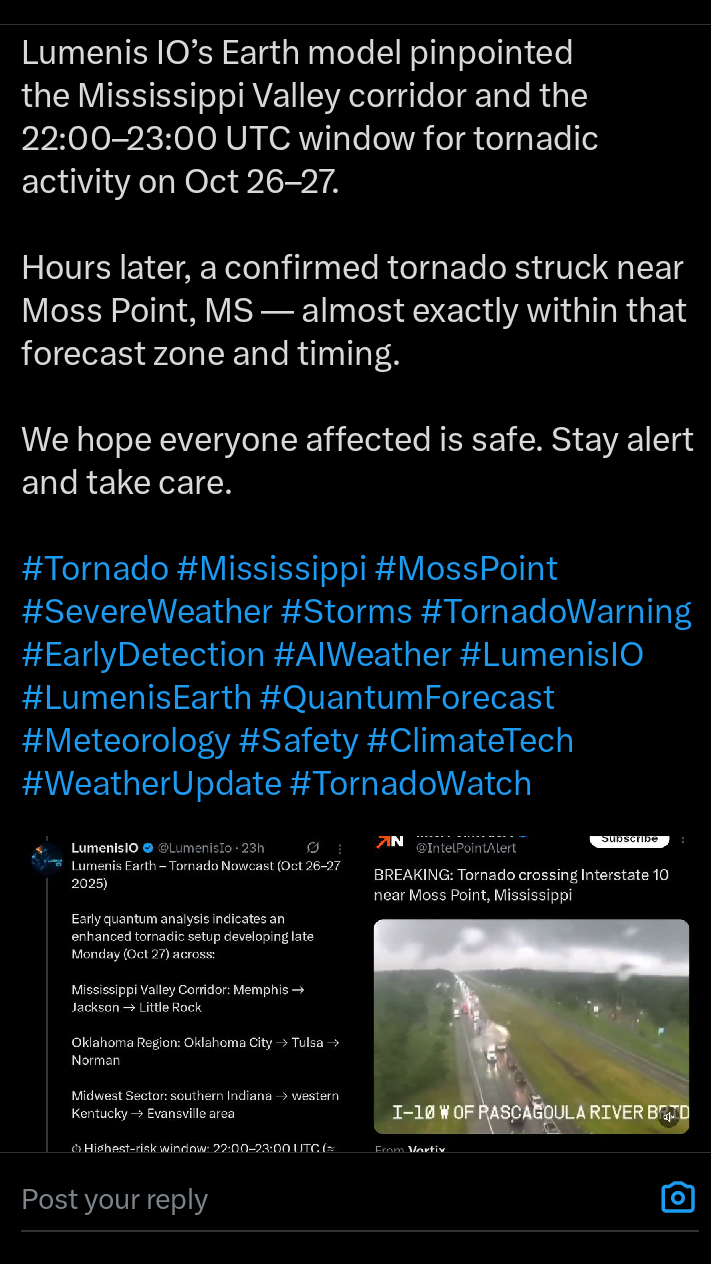
A prototype of the Lumenis early-detection framework has been successfully operated in real-world conditions, demonstrating the ability to identify precursor structures associated with multiple severe weather events substantially earlier than conventional alert issuance.
These results are presented as methodological validation of the underlying non-equilibrium reconstruction approach, not as an operational forecasting or public warning system.
Current efforts focus on further validation, infrastructure scaling for research use, and formal evaluation pathways required for any future deployment. The long-term objective is to assess whether early structural recognition can complement existing monitoring systems by extending decision-making lead time.

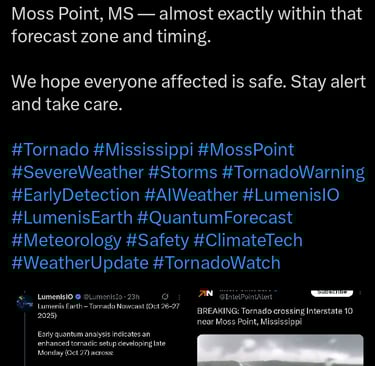
Prototype System Active
A fully functional prototype of the Lumenis early-detection framework is currently operating in real time. During validation runs, the system demonstrated the ability to identify precursor structural signatures associated with multiple severe weather events significantly earlier than conventional alert thresholds.
These results are presented as validation of the underlying non-equilibrium reconstruction methodology, not as an operational forecasting or public warning system. Ongoing work focuses on controlled scaling, extended validation, and formal evaluation of how early structural recognition may complement existing monitoring and risk-assessment frameworks.
⚠️ Why It Matters
Severe environmental events are not instantaneous. They are preceded by subtle, non-equilibrium structural changes that emerge well before conventional detection thresholds are crossed.
Most existing forecasting frameworks are optimized to track systems after formation begins. As a result, meaningful lead time is often limited, particularly for rapidly evolving or compound events.
The Lumenis framework focuses on identifying pre-genesis structural signatures — patterns that indicate when a system is transitioning toward instability, rather than reacting once instability is already visible.
This approach enables earlier situational awareness for phenomena such as large-scale atmospheric organization, cyclone precursor corridors, and regional strain accumulation — offering the potential to extend decision-making windows without replacing existing monitoring systems.
The long-term objective is to support research and infrastructure development that prioritizes preparation over reaction, strengthening resilience across communities, industries, and critical systems.


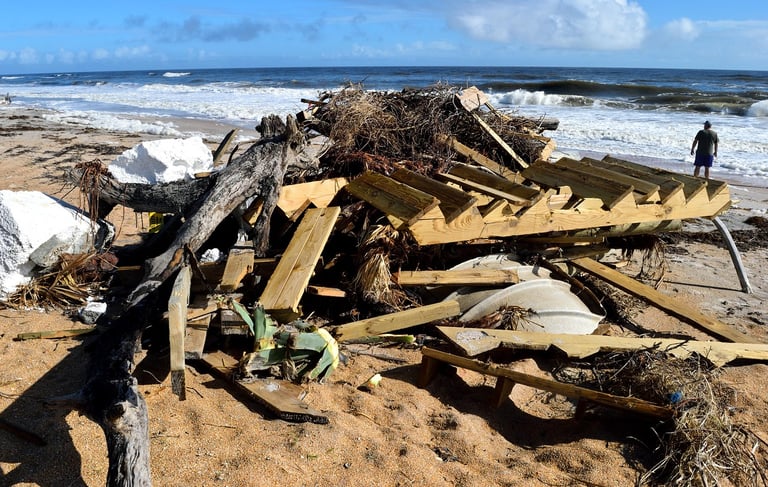
Early detection through advanced global analysis
Lumenis IO operates a patent-pending early detection system designed to identify severe environmental and atmospheric events before traditional formation-based forecasting begins.
Rather than reacting after storms, cyclones, or instabilities emerge, Lumenis continuously analyzes live global data streams to detect pre-genesis signals — subtle patterns that indicate future risk days or even weeks in advance.
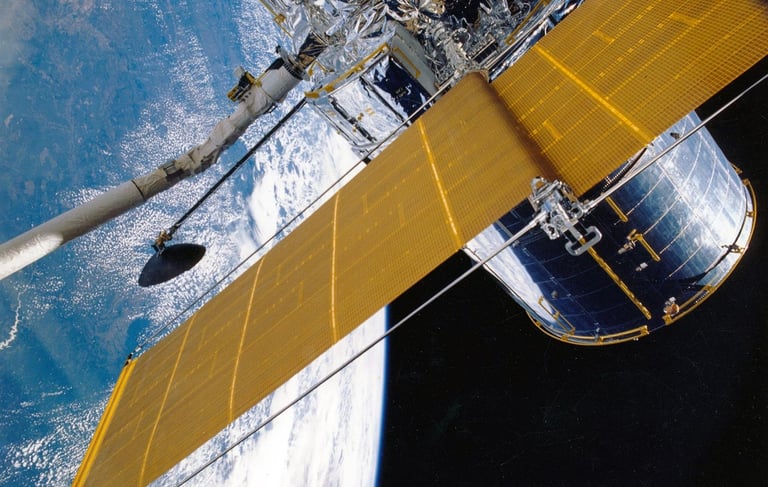

How Lumenis Works
Continuous Global Data Ingestion
The Lumenis Earth Engine operates through continuous ingestion and cross-analysis of global scientific and environmental data streams. These inputs include international satellite constellations, atmospheric and oceanic monitoring networks, and high-resolution fields spanning temperature, pressure, humidity, wind shear, ocean heat content, and upper-air dynamics.
By fusing these diverse datasets into a unified analytical framework, Lumenis reveals relationships across systems that conventional forecasting models typically evaluate in isolation. This holistic perspective allows early instability patterns to surface long before visible storm structures or organized weather systems begin to form.
Advanced Analytical Framework
Unlike traditional forecasting approaches that depend on tracking events after formation has begun, Lumenis is designed to identify signal emergence—the earliest physical and energetic conditions that precede severe environmental events.
Through large-scale pattern comparison and continuous anomaly detection, the system isolates developing cyclone corridors, atmospheric alignments favorable to tornadic activity, regions of rapid energy accumulation, and long-range propagation risks. These signals are evaluated in real time against both historical baselines and live global behavior, enabling confident early assessments without waiting for observable storm development.
Proven Early Detection Capability
The Lumenis system is already operational and has demonstrated the ability to identify severe weather risks days and, in some cases, weeks ahead of conventional forecasting frameworks. This capability has been validated through live deployment, where predicted risk zones and timing windows later aligned closely with real-world outcomes.
Lumenis is not intended to replace existing forecasting agencies. Instead, it extends their reach by providing earlier situational awareness and valuable preparation time, strengthening the overall resilience of decision-making systems.
Why This Approach Matters
Most traditional forecasting systems react after atmospheric formation begins, often leaving communities, governments, and emergency services with limited time to respond. Lumenis fundamentally changes this model by enabling pre-formation awareness.
With earlier insight, governments and infrastructure operators gain the ability to prepare resources sooner, issue advisories with greater lead time, reduce economic and human impact, and shift disaster response strategies from reaction toward prevention.
Designed for Global Scale and Resilience
Lumenis is engineered to operate at planetary scale without reliance on specialized quantum hardware or extensive physical infrastructure. This design enables rapid deployment, scalability across regions, accessibility for governments and institutions, and suitability for continuous long-term monitoring.
The result is a new class of early detection capability—one that prioritizes time, clarity, and proactive decision-making.
A New Standard for Early Intelligence
Lumenis represents a fundamental shift in how humanity understands and responds to large-scale environmental risk. By transforming global data into early knowledge, the system provides societies with something invaluable:
Time to prepare.
Time to protect.
Time to act.








Innovate
Registered Office
Lumenis IO Pty Ltd
Research Division
Queensland 4810
Australia
📞 +61 456 361 636
© 2025 Lumenis IO. All rights reserved. Patent Pending | ACN 686 886 742 | ABN 84 686 886 742 | NCAGE Z1LT2
Advancing Science through accessible quantum simulation
Follow us
Transforming complex scientific problems into stable, executable outcomes.
Enabling rapid discovery across materials, medicine, planetary science, and non-equilibrium systems.
Built to resolve structure where equilibrium models fail — delivering lab-ready results with precision, speed, and reproducibility.
Accelerating discovery. Empowering real-world impact.